Skip to content
Inovatica AGV
Menu
ROI Calculator Book a demo
AGV / AMR technology

Safety

Safe AGV and AMR operation on site and the requirements of ISO 3691-4.

Technology and rollout

Safety (ISO 3691-4)

ISO 3691-4 is the foundation of AGV and AMR safety. It structures risk assessment, zone design, the reliability of safety functions and the responsibilities of every party involved in the rollout.

Executive summary

Compliance with ISO 3691-4 is not only the basis for CE certification, but above all a practical way to protect people, infrastructure and process continuity.

Business impact
easier CE certification and clearer alignment with European safety requirements
lower risk of accidents, asset damage and unplanned process interruptions

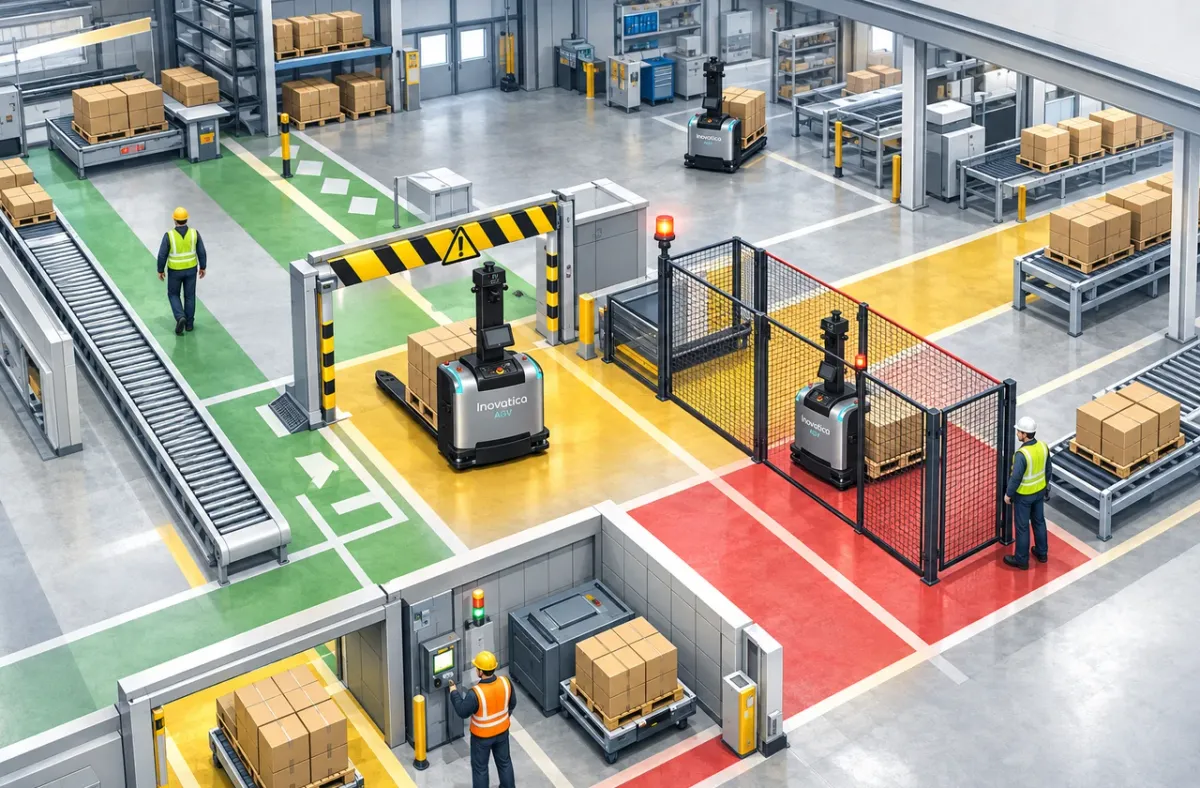
Zone legend

Warehouse illustration with AGV safety zones, conveyors and fenced operating areas.
1

Operating zone

Open working area with maintained evacuation clearance and predictable AGV traffic.

2

Operating hazard zone

Narrow section with reduced speed and additional warning logic.

3

Restricted zone

Area reserved for authorized personnel only.

4

Confined zone

Fenced and closed operating space for AGV movement.

5

Load transfer area

Handover point connected to a conveyor, dock or transfer interface.

Automating internal transport with AGV trucks and autonomous mobile robots AMR is a major step towards higher logistics and manufacturing efficiency. For people and machines to work together safely, however, the whole system has to be built on rigorous and modern standards. The most important one is ISO 3691-4, which replaced the older EN 1525 approach and defines safety requirements for driverless industrial trucks and their systems in a much more precise way.

The standard is built around several core pillars. The first is a comprehensive risk assessment aligned with ISO 12100 and carried out for the specific plant and the specific process. This includes collision points, floor conditions, visibility, personnel presence and realistic traffic scenarios. The outcome of that analysis determines which preventive measures must be designed into the project before the system is allowed to operate.

The second pillar is work-zone management. ISO 3691-4 distinguishes the operating zone, operating hazard zone, restricted zone, confined zone and load transfer area. In practice this means different requirements for clearances, speed limits, signalling and the way each area is protected. Defining those zones correctly allows the rollout team to protect people without sacrificing throughput across the facility.

The third pillar is the reliability of the safety functions themselves. In line with ISO 13849-1, critical functions such as braking, personnel detection and speed monitoring usually need to achieve Performance Level d. In practice this requires redundant safety architectures in which a single component failure does not result in the loss of the protective function or a sudden increase in risk for operators and nearby staff.

ISO 3691-4 also makes it clear that safety is a shared responsibility. The OEM is responsible for delivering a safe machine in its factory state. The system integrator is responsible for implementing that machine safely in the real customer environment, including maps, scanner fields, speed reductions and interaction logic. The end user is responsible for safe day-to-day operation, keeping transport paths clear, training employees and carrying out regular audits and inspections.

In practical terms, investing in a system that complies with ISO 3691-4 means greater reliability, better protection of employee health and a more stable logistics operation around the clock. It is a standard that structures the project from the technical, legal and operational side at the same time, and it shortens the path to a safe rollout in a real industrial environment.

risk assessment aligned with ISO 12100 and zone design for the specific facility

high-reliability safety functions, typically designed to meet Performance Level d

clear responsibility split between the OEM, the system integrator and the end user
See how AGVs detect and avoid obstacles in 3D
Vehicle and facility audit

AGV / AMR safety audit

We assess an autonomous vehicle and its integration into a specific facility against PN-EN ISO 3691-4:2024-01. The audit identifies nonconformities, estimates residual risk and sets out corrective actions before commissioning or continued operation.

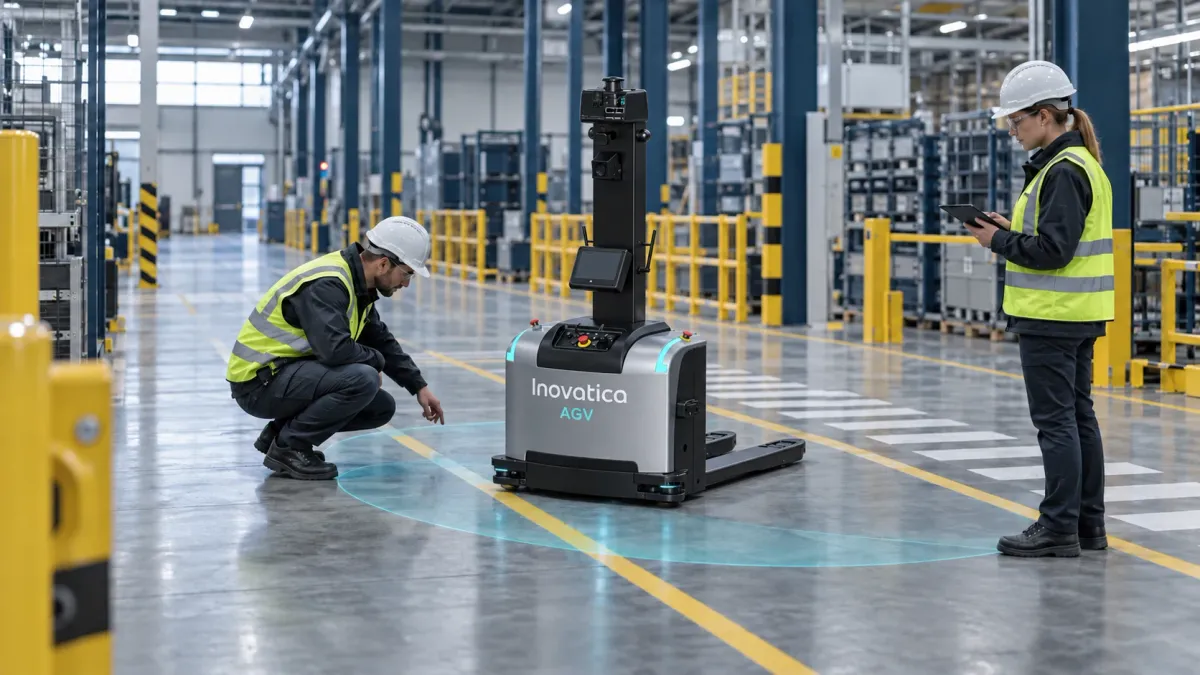
Safety auditors inspect an autonomous AGV, its scanner and traffic area in a facility
Vehicle · safety functions · facility

What the audit covers

Area 01

Documentation and formal conformity

  • EC/EU declaration of conformity, CE marking and nameplate
  • Operating instructions and technical documentation
  • Manufacturer’s risk assessment under ISO 12100
  • Effect of vehicle modifications on conformity assessment
Area 02

Safety functions and control

  • Scanners, speed limitation and emergency stop
  • Comparison of achieved PL with the required PLr for each function (for example PL d / PL e and Category 3 where specified)
  • Architecture, MTTFd, DC and CCF analysis, using SISTEMA where applicable
  • Emergency-stop review under ISO 13850
Area 03

Traffic and detection zones

  • Scanner protective fields against speed and stopping distance
  • Positioning of protective equipment relative to approach speed under ISO 13855
  • People and obstacle detection and warning zones
  • Behaviour at intersections, narrow passages and doors
Area 04

Facility integration and operation

  • Routes, markings and separation from pedestrian traffic
  • Areas shared by people and vehicles
  • Charging stations and load-transfer points
  • Emergency and intervention procedures for operators

Assessment framework

We select standards and requirements according to the vehicle, its safety functions and the legal framework applicable to the project.

PN-EN ISO 3691-4:2024-01
driverless industrial trucks and their systems
ISO 12100
risk assessment and risk reduction
ISO 13849-1/-2
safety-related controls and validation
ISO 13855
positioning of protective equipment
IEC 60204-1
electrical equipment of machines
ISO 13850
emergency stop
See the standard in the PKN catalogue

How the assessment works

1

Site review

Inspect the vehicle, routes and real operating conditions in the facility.

2

Measurements and tests

Check stopping distance, reaction times, protective-field range and traffic scenarios.

3

Verification

Review documentation and the configuration of safety functions and systems.

4

Risk assessment

Assess hazards using R = S × E × O, assign RL1–RL5 levels and define corrective actions.

Audit deliverable

Report with findings and corrective actions

The report documents measurements and tests, risk before and after corrective actions for identified hazards, recommendations and conclusions on the conditions for safe operation.

Ask about an audit
AGV / AMR safety · ISO 3691-4

AGV on the shop floor: 12 points you need to check

A quick checklist for HSE, maintenance teams and employers operating autonomous industrial trucks. Use it as a first review before start-up, an audit or a change in AGV configuration.

Worth remembering

An audit is a snapshot. A facility is a movie.

An assessment confirms the state on one day, while the working environment changes every day.

Worth remembering

Formal compliance does not always mean real safety.

A technically functional machine may still create legal and operational risk because of missing documentation or an incomplete operating model.

Worth remembering

Ask for numbers.

Risk level R, Performance Level PL and speed thresholds are measurable evidence, not slogans.

Unsure about even one point?

Let us review the risks before AGV start-up

We offer a free 30-minute consultation and a full AGV safety audit according to ISO 3691-4 for a specific facility, process and vehicle configuration.

Book a consultation
Next step

Discuss your AGV rollout

We can connect technology, safety and business goals with the requirements of your process.