
6 independently protected sectional doors
Case study / Manufacturing / Safety
Doors that don’t close on forklifts
How a UWB positioning system protects six sectional doors by detecting 13 forklifts before they enter the doorway — without floor works or dependence on the plant’s IT network.
Published: December 18, 2025
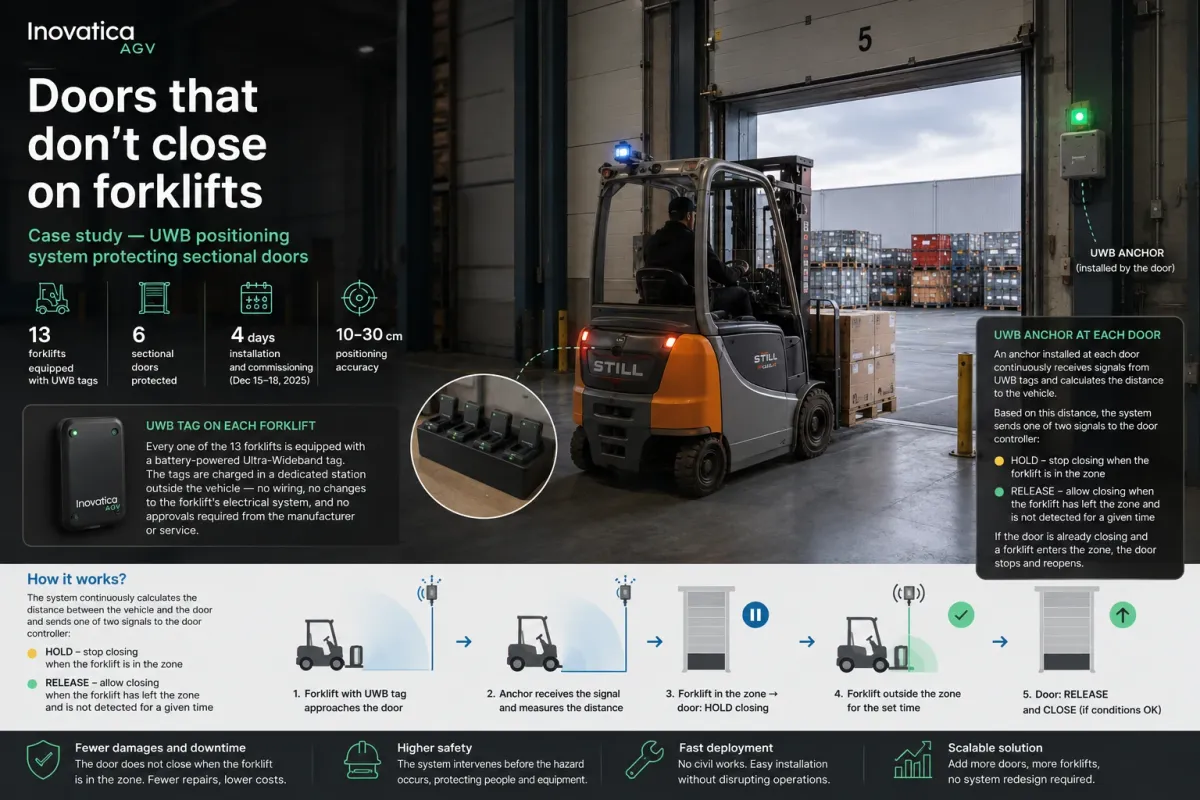
13 forklifts equipped with battery-powered UWB tags
4 working days, including installation and commissioning
10–30 cm positioning accuracy
A manufacturing plant needed to prevent automatically closing sectional doors from striking forklifts that were still manoeuvring near the doorway. Inovatica AGV deployed a local UWB positioning system across six doors and 13 forklifts in four working days. The system has operated continuously since commissioning in December 2025, with no changes to its hardware configuration.
Challenge
Sectional doors in production halls often close automatically after a preset time or once a vehicle has passed. The risk appears when a forklift is manoeuvring near the door, reversing, waiting for space to clear or carrying a load that extends beyond the vehicle’s outline. The door starts descending, and the operator may notice only when it is already too late.
The consequences are twofold. Damage to a door or forklift mast creates direct repair costs and leaves the doorway unavailable until the repair is complete. More importantly, every such incident happens in the operator’s immediate vicinity.
Standard door safeguards, including photocells and safety edges, react to an object that is already in the doorway. They do not know that a forklift is approaching, waiting two metres away before moving again or returning for another pallet. They respond to an obstruction, not to the wider operating situation.
Approach
Instead of adding more sensors to the door itself, the project reversed the logic: the vehicle tells the door that it is present.
Each of the 13 forklifts was equipped with a battery-powered Ultra-Wideband tag. The tags are charged in a dedicated station outside the vehicle, so installation requires no wiring, no changes to the forklift’s electrical system and no approvals from the vehicle manufacturer or service provider.
A UWB anchor was installed beside each of the six doors. It continuously receives the tags’ signals and calculates the distance between the vehicle and the doorway. Based on that distance, the system sends one of two signals to the existing door controller:
- HOLD: stop the closing sequence while a tagged forklift is inside the defined zone.
- RELEASE: allow the door to close after the forklift has left the zone and has not been detected for a set period.
If a door is already descending when a forklift enters the zone, the door stops and reopens.
Design decisions that mattered in daily operation
- Each door operates independently. Six doors use six autonomous control sets. A fault at one doorway does not stop the others, and adding another door does not require changes to the systems already in service.
- The system does not use the plant’s IT infrastructure. Communication remains local between the anchor and the control box at the door. The solution does not depend on plant Wi-Fi or customer servers, removing an entire class of technical failure modes and simplifying deployment coordination.
- Coverage extends to both sides of the doorway. Anchors were installed two to four metres above floor level so that a tag can also be detected while the forklift is still outside the building and approaching the entrance.
At the busiest doorway, warning lights were added to indicate door movement for pedestrians and for vehicles that are not fitted with UWB tags.
Why not an induction loop or a laser scanner?
An induction loop detects a mass of metal above a defined section of floor. It can determine whether something is directly over that point, but not where a vehicle is nearby or what it is about to do. A forklift waiting two metres from the doorway, reversing to correct a pallet’s position or approaching from outside remains invisible until it drives precisely over the loop. Installation also requires cutting into the floor, and each loop covers only one fixed detection zone.
A laser scanner is a closer alternative, but it requires line of sight. It cannot detect a forklift approaching from behind a wall, a rack or a parked trailer. It also cannot distinguish a vehicle from a pallet left in the detection area, which can keep the door open until the obstruction is removed. Neither approach identifies a specific vehicle, so neither supports logic based on that vehicle’s identity.
Both technologies have one advantage that UWB does not: they work for every vehicle, including those without additional equipment. This is why warning lights were added at the doorway with the highest traffic volume.
These technologies operate at different layers. Photocells, safety edges and scanners remain the protective layer that reacts to an object in the doorway. UWB acts earlier, informing the door about an approaching vehicle before it reaches the opening. The aim is not to replace the existing safeguards, but to reduce the number of situations in which they need to intervene.
Deployment
Every door was tested individually in six scenarios:
- holding the door when a tag was inside the zone,
- releasing the door after the tag left the zone,
- stopping and reopening a door that was already moving,
- confirming communication with the existing door controller,
- confirming correct warning-light operation,
- verifying correct system restart after a power loss and power restoration.
Tests were conducted from both inside and outside the building. The system has run continuously since commissioning without changes to its hardware configuration.
Scope
- 13 battery-powered UWB tags fitted to forklifts,
- 6 UWB anchors with mounting brackets,
- 6 independent control boxes connected to the existing door controllers,
- warning lights at one high-traffic doorway,
- positioning accuracy of 10–30 cm.
Important safety note
The system controls the door-closing logic based on vehicle position. It does not replace the door manufacturer’s safeguards or any functional-safety components. Photocells, safety edges and all other protective devices remain unchanged and continue to perform their original functions. The solution reduces the number of situations in which those safeguards need to activate.
Why the architecture scales beyond one plant
The solution requires no floor works, does not depend on the plant network and integrates with existing door controllers. It scales in both directions: more doors and more vehicles can be added without rebuilding the equipment already in operation.
The same architecture can support other vehicle-positioning scenarios, including reduced-speed zones, approaches to pedestrian crossings, and control of lighting or ventilation in forklift operating areas.
Do you face the same problem?
If sectional doors in your plant operate close to forklift traffic, Inovatica AGV can prepare a feasibility assessment covering the doors and travel routes, the required number of anchors and tags, and the integration scope for the existing controllers. The assessment concludes with a defined project scope and quotation.
This case study is published with the client’s permission in anonymised form.
Next step
Do sectional doors operate close to forklift traffic in your plant?
We can assess your doors and travel routes, specify the required anchors and tags, and define the integration scope for your existing controllers.