

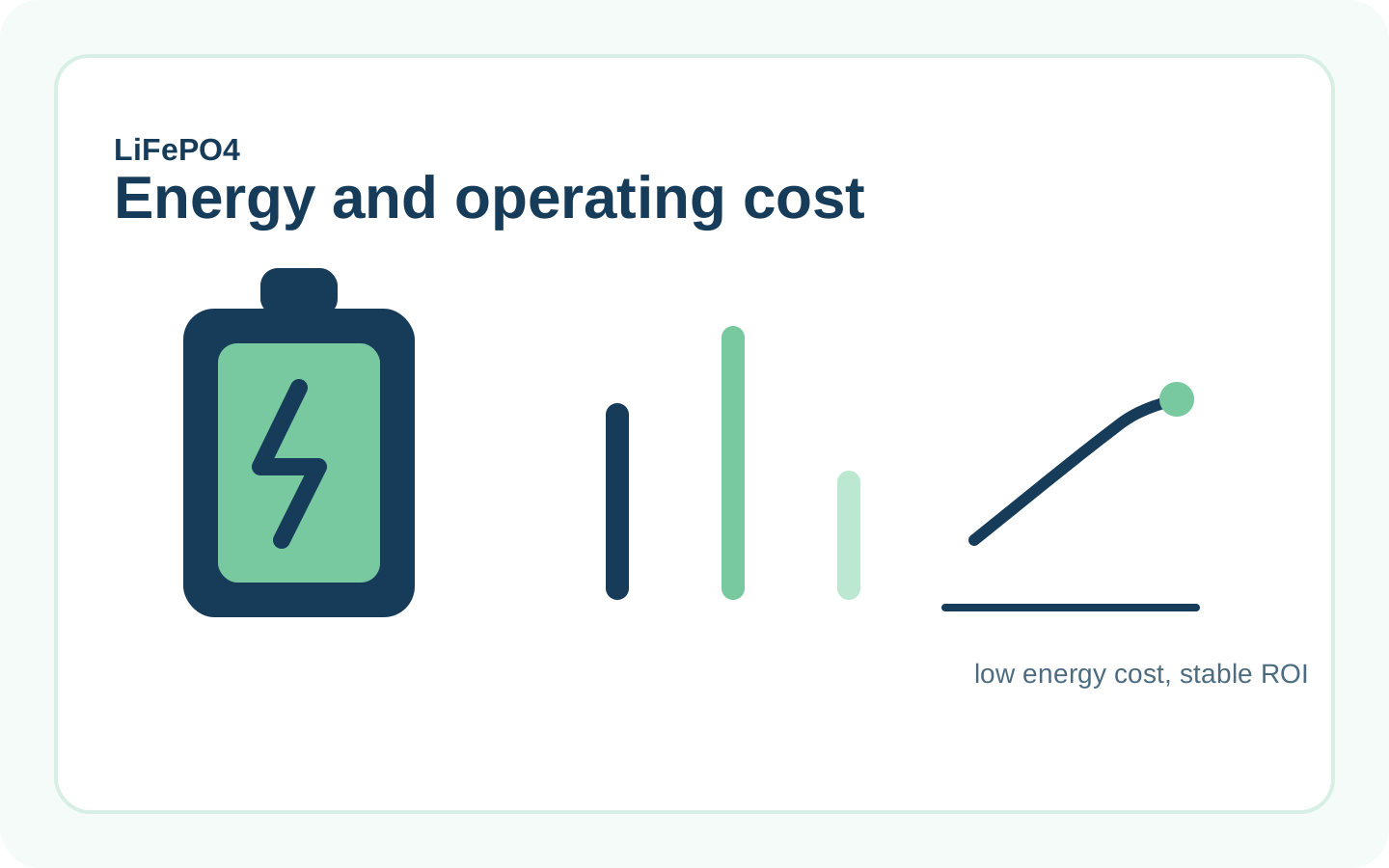
LiFePO4 batteries are often discussed in terms of chemistry, but for the buyer the real question is simpler: what does that mean for uptime, charging strategy and operating cost. These factors influence both daily use and the wider ROI model.
A useful cost analysis should include energy consumption, charging windows, battery life assumptions and the operational effect of more predictable availability. Only then does the battery choice become a meaningful business decision.
AGV investment discussions often emphasize the purchase price and operator costs. It is useful to separate the initial project cost from the subsequent cost of everyday operation. For vehicles with LiFePO4 batteries, the latter can be lower than first-time automation buyers expect.
What LiFePO4 technology offers
Lithium iron phosphate batteries are used in AGVs for their combination of long service life, thermal stability and energy efficiency. They can support extended operation and opportunity charging between tasks or during planned process windows.
For the plant, this can mean fewer battery replacements and simpler charging arrangements. These considerations become especially relevant when the fleet must operate across multiple shifts with limited maintenance downtime.
How much the energy costs
The source uses an example with a 24 V, 210 Ah battery, equivalent to approximately 5 kWh of nominal stored energy. In the illustrated operating context, electricity remains a relatively small cost compared with labour, maintaining manual transport or losses from an unstable process.
For total cost of ownership, energy alone is therefore unlikely to determine the business case. Fleet utilization, the service model, shift patterns and suitability for the actual process can have a much greater effect. The battery’s nominal capacity is not a measurement of electricity consumed per shift; actual use and charging losses need to be measured.
Where operating costs arise
The calculation must also include inspections, consumables, a repair allowance and service support. These costs can be more predictable in a well-maintained system, particularly under a full-service arrangement or a clearly defined service-level agreement.
The potential advantage of a longer-lived battery is less replacement-cost pressure in the early operating years. This supports cost stability and helps explain the investment to the finance team. Battery-life assumptions still need to match the duty cycle and supplier conditions.
What this means for ROI
A low energy cost supports the project but does not justify a deployment on its own. AGVs need a process with sufficient transport volume and trip frequency. The business case comes from combining operating costs with achievable reductions in manual work, better availability and more stable material flow.
Treat energy as one component of the calculation. When the process is well selected, LiFePO4 can help keep the fleet’s daily operating cost low and reduce uncertainty in later years.
Key takeaway
LiFePO4 can support relatively low, predictable operating costs. The investment discussion should still focus on process selection, integration and reliable operation after commissioning. A battery choice is useful only when its effect on charging, availability, lifetime and cost is evaluated in that wider context.
Supporting material: Original source ↗