
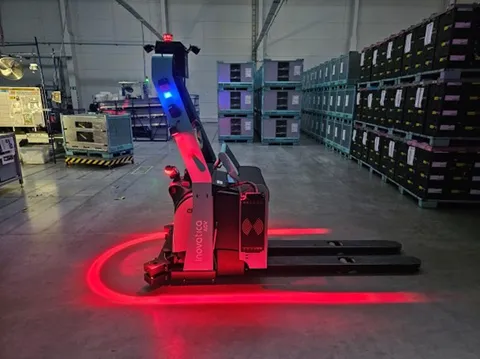
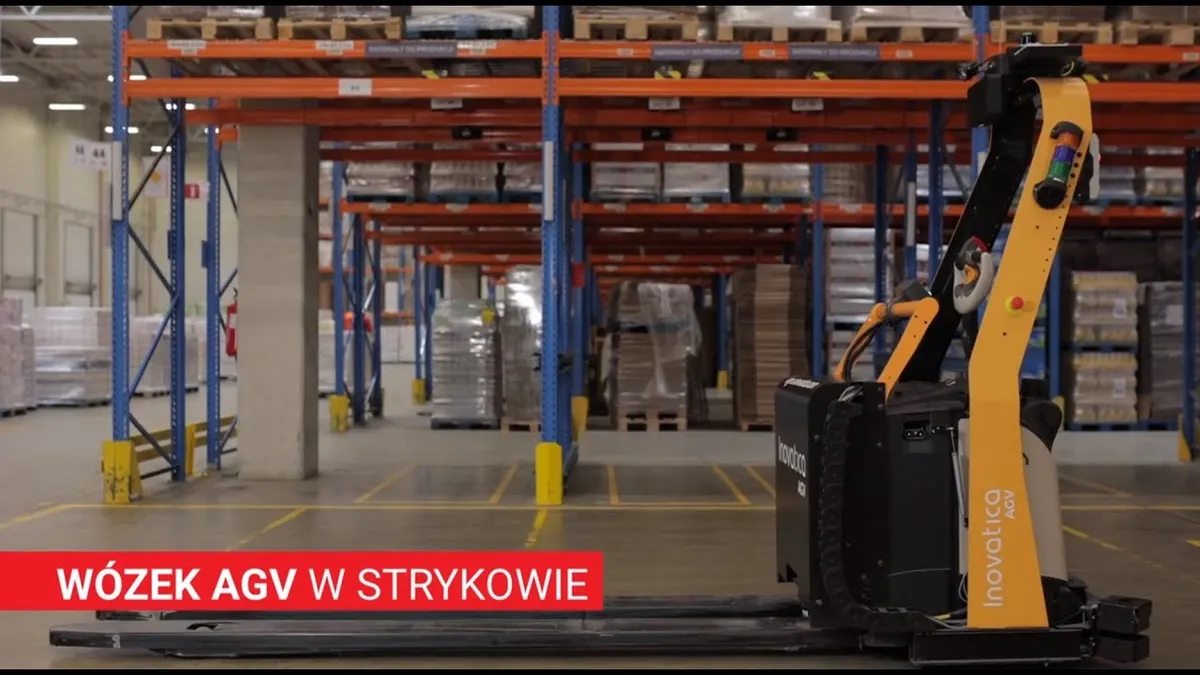
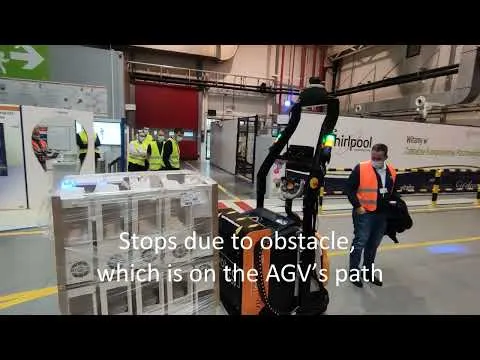
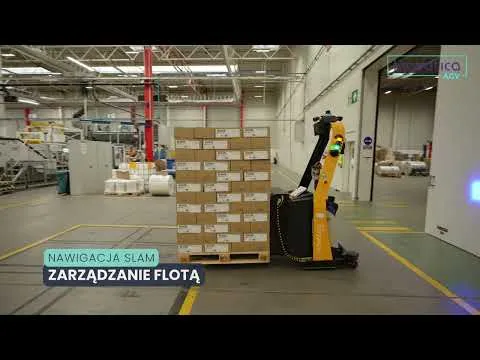
AMR can increase flexibility in internal transport, but the practical value depends on the process. The key questions are not only how the robot navigates, but whether the environment, traffic logic and task model support a stable rollout.
For many teams the most useful comparison is still AGV versus AMR in a specific use case: fixed routes, changing routes, interaction with people, load carrier type and system integration. That comparison is what turns a technology discussion into an investment decision.
AMR should therefore be assessed as part of a wider operating model that includes safety, systems integration, charging strategy and the organization of daily exceptions.
Flexible navigation is useful when the process, traffic rules and task management are ready for it.
- Assess navigation in the actual environment.
- Plan safety and integration together.
- Start with a measurable pilot.
AGV and AMR in practice
Same destination. Different route logic.
The route is clear. Transport can proceed.
Transport waits for the defined route to clear.
The route is clear. Transport can proceed.
An alternative route is available within the allowed area.
Illustrative example. Actual behaviour depends on the navigation system, permitted zones and safety configuration. Hybrid approaches also exist.
| What matters | AGV | AMR |
|---|---|---|
| Route | Defined physical or virtual routes. | A route planned within the permitted map area. |
| Blocked path | Typically stops and waits for the route to clear. | May choose another permitted path if one is available. |
| Process changes | Review routes and their configuration. | Review the map, zones and traffic rules. |
| Load and throughput | Check the specific vehicle and the full transport cycle. | Check the specific vehicle and the full transport cycle. |
Navigation comparison: SSI SCHAEFER ↗
How AMRs differ from AGVs
The practical distinction concerns navigation and responses to changes along the route. Autonomous navigation can support alternative paths and changes to pickup and drop-off locations, within the permitted operating area.
These capabilities can help reduce guidance infrastructure and make later process changes easier. Their value still depends on clear traffic rules, prepared transfer points and an orderly process.
The capability comes from combining the drive system, sensors, software, perception and decision-making. It can include obstacle avoidance, automatic task allocation across several robots and changes to the site layout. Operational disorder still makes work standards, right-of-way rules and site preparation essential.
Navigation determines practical usefulness
Laser navigation and SLAM systems support mapping and localization. The robot uses information about its surroundings to navigate within the configured area.
Accurate docking can still require additional position correction or clear reference points. Flexible navigation does not remove the need to assess the real working environment.
Mapping and localization allow routes to respond to the current situation. They can reduce infrastructure changes, shorten the first commissioning stage and support later process changes in environments shared with people and other vehicles.
Where artificial intelligence can help
Useful applications address a specific task, such as recognizing objects, obstacles or pallets. Analysis of robot operating parameters can also support maintenance planning.
These functions should be evaluated by their contribution to system reliability and operational performance.
For Inovatica AGV, object, obstacle and pallet recognition and predictive maintenance are two important areas. Predictive maintenance uses operating parameters to anticipate service needs before a failure. AI can also support analysis of the surroundings and fleet behaviour, provided it improves reliability rather than only a single vehicle specification.
Safety extends beyond the scanner
Mixed-traffic operation requires the assessment of technical measures, process design and people working in the area.
- Technical measures include sensing, speed control and stopping functions.
- Process design covers routes, zones and transfer points.
- People need training and clear rules for working with robots.
The complete installation and working environment must be assessed. A vehicle specification alone does not establish that a deployment is safe.
Practical technical measures include safety scanners, lights, audible warnings, emergency-stop buttons and speed-reduction logic. These work alongside the process and human layers; even a capable robot cannot compensate for unclear rules or people who have not been prepared to share its workspace.
Constraints to assess before deployment
Common practical issues include an unclear process, unreliable wireless coverage, insufficient fleet coordination, neglected sensor or battery maintenance and limited staff preparation.
Deployment changes how people work. The team needs to understand the task flow, daily exceptions and responsibility for keeping the system operational.
Maintenance includes sensors, lidar and batteries. Staff preparation is also an organisational change: people need to understand and trust the system, rather than only learn a new technical procedure.
How to approach an AMR purchase
A limited pilot can test the selected process and provide measurable operating results before expansion. Define its scope, acceptance criteria and the data needed to evaluate performance.
Assess load handling, integration, local service, deployment complexity and the supplier’s relevant references together. The purchase includes the wider operating system as well as the vehicle.
A first stage often uses one robot or a small pilot to verify the technology and its impact on KPIs. Match vehicle parameters to the use case and consider the ease of later changes, actual ROI, supplier experience and reference deployments alongside integration and local support.
Directions for further development
The original article discusses improved perception, broader systems integration, interoperability such as VDA 5050, and operating analytics as areas of development.
For an operator, the useful measure remains the resulting material flow: whether it is more predictable and can expand with the process.
The directions described in the source material include integration with WMS, ERP and fleet management, predictive functions and more flexible operation both inside and outside buildings. These are development directions, not a promise that every vehicle supports every environment. A practical outcome is lower dependence on manual transport as well as stable flow and easier scaling.
What to take into a deployment
Evaluate AMRs against a defined process, with suitable fleet management, staged commissioning and attention to people, safety and site constraints.
The Polish article draws on material published in Glowny Mechanik in May–June 2024. The discussion is an introduction to the topic rather than a specification for a particular robot.
A floor plan, load details and peak-hour transport demand are a useful starting point for a project discussion.