

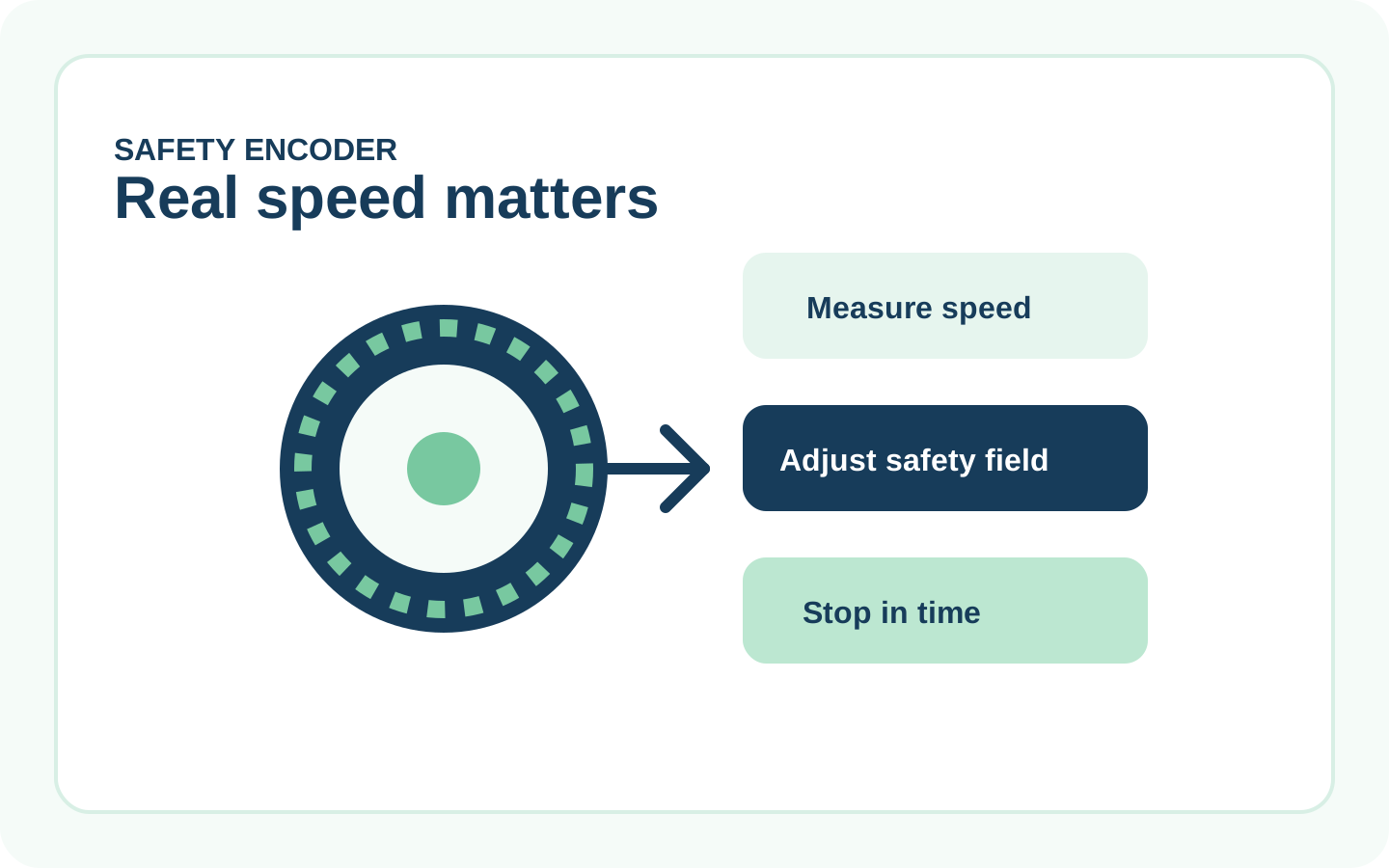
A safety scanner can detect an obstacle, but it does not by itself guarantee that the vehicle understands its real speed and braking behavior accurately enough. That is where the safety encoder becomes important in AGV architecture.
Its role is directly linked to functional safety, speed monitoring and controlled stopping performance. In practice, this makes it a critical component for both compliance and predictable behavior in mixed-traffic environments.
Safety assessments often focus on visible equipment: scanners, emergency-stop buttons and the CE marking. Components inside the control system also matter. A safety encoder provides dependable motion feedback for the vehicle’s safety functions.
Why a scanner alone does not solve the problem
Detecting an obstacle does not ensure that a truck will stop in the available space. Protective-field selection and stopping-distance calculations need a reliable indication of actual vehicle speed. If the controller relies on incorrect or unverified feedback, the protective zone may be insufficient.
This can increase risk in mixed traffic, particularly near people, racks and transfer points. For the customer, reliable feedback is therefore part of predictable behaviour in the real workplace, rather than merely a component-level detail.
What the safety encoder does
In an appropriate safety architecture, the encoder supplies information about speed and direction to the safety controller. This supports functions that:
- check whether the vehicle stays within the specified speed;
- select the scanner’s protective fields according to operating conditions;
- establish the distance needed for a safe stop;
- move to a safe state when a measurement fault is detected.
These functions need to form a coherent, validated safety architecture. A collection of individually capable components is not sufficient by itself.
Relationship with ISO 3691-4
ISO 3691-4 addresses safety requirements and their verification for driverless industrial trucks and their systems. An assessment must therefore consider how safety components and control logic work together during actual operation, including interaction with people.
Without reliable speed feedback, it is difficult to justify the operation of speed-dependent protective fields in the risk assessment. Ask how speed is monitored, which feedback is used and how the complete function is validated. The presence of a particular encoder alone does not prove conformity, and this article does not state that every compliant design must use the same component arrangement.
What to ask a supplier
Request specific information rather than only a general conformity statement:
- the type of encoder or motion-feedback solution;
- the relevant Performance Level (PL) or Safety Integrity Level (SIL);
- how the safety controller monitors speed;
- the response to a measurement fault or lost signal;
- how the functions are documented in the risk assessment.
Together, these details make it possible to assess the control architecture rather than relying on appearance or a catalogue list of components.
What this means for the investor
The outside of an AGV shows only part of its safety design. The control architecture and the reliability of the data used by safety functions are equally important.
A safety encoder illustrates why a component with little marketing visibility can have a substantial effect on project risk. Reducing operational risk should be one of the main criteria when selecting an AGV or AMR system.
Standard scope: ISO 3691-4:2023 — driverless industrial trucks and their systems.
Supporting material: Original source ↗